
Plymouth County Wanted Sources
Don't expect a most-wanted roster from the Plymouth County Sheriff's Office. The agency posts none. No fugitive page, no searchable warrant database either. Its official Safety page sends visitors elsewhere: MassMostWanted. That regional network is backed by the Massachusetts Bankers Association and maintained by Metro-LEC. Investigators from departments across the state feed it their cases. The sheriff's endorsement makes it a solid local lead, but nothing more. It is not a county government roster.
What appears there? Fugitives and unidentified crime suspects, searchable by keyword, crime type, city, or date. Plymouth County communities show up, but so does the rest of Massachusetts. Listings come and go as agencies post updates, make arrests, or close cases. There is no fixed county count. A page date proves nothing about whether a warrant is still live.
Two statewide options exist as well. The Massachusetts State Police Most Wanted page covers state police targets. The Massachusetts DOC Most Wanted page tracks escaped state prisoners. Neither shows recent bookings at Plymouth County Correctional Facility. The agencies differ, the custody statuses differ, and the reasons for listing people differ too.
Plymouth County Wanted Listing Fields
Every MassMostWanted case comes from an investigating agency. The details shift from one entry to the next. Some name a fugitive outright. Others show a surveillance frame and simply ask who the person is. Check the source label before you call any picture a mugshot.
| Field | What it may show |
|---|---|
| Name or subject | A named person, alias, or an unidentified suspect description. |
| Case number | The reference used by the submitting agency or regional network. |
| Agency and city | The investigator responsible for the notice and the place tied to the case. |
| Case details | A crime description, date, wanted or fugitive label, and status supplied for publication. |
| Image | A portrait, surveillance frame, crime-scene image, or another agency-approved picture, not necessarily a booking photo. |
| Reward or tip route | Any reward statement and the directions for sending information to the responsible agency. |
The network's FAQ puts each submission in the hands of the assigned detective. Resolved cases come down through a stated removal process. Until the source agency confirms status, an old page tells you little. Its charge wording may not match what the court record ultimately shows.
Use Plymouth County Wanted Lists
Begin with the agency that posted the notice. A regional listing can steer a tip in the right direction, yet only the submitting police department or state unit can say where the case stands now. Write down the case number, city, and agency together. That way your report lands with the right investigator.
- Open the sheriff’s Safety page, then follow its MassMostWanted link, or open the State Police list for an official statewide fugitive notice.
- Read the complete entry. Check the submitting agency, city, case date, image source, and any caution or reward language.
- If the person or event is familiar, use the tip method named in that entry. Give facts such as the case number, place, time, and what was directly observed.
- Do not contact, follow, detain, or warn the person. Call 911 when there is an immediate threat.
- After an announced capture, use the Plymouth County booking and court lookup paths to distinguish current custody from the later case outcome.
An arrest does not guarantee an online PCCF photo. The county has no stable public detainee results page and no booking-photo feed. The arresting agency, the jail, and the court each hold different pieces of the file, and a case can move into state, federal, or another county's custody.
The manifest image below shows the regional page the sheriff links to as its public wanted list. For current submissions, view the live MassMostWanted fugitive page.
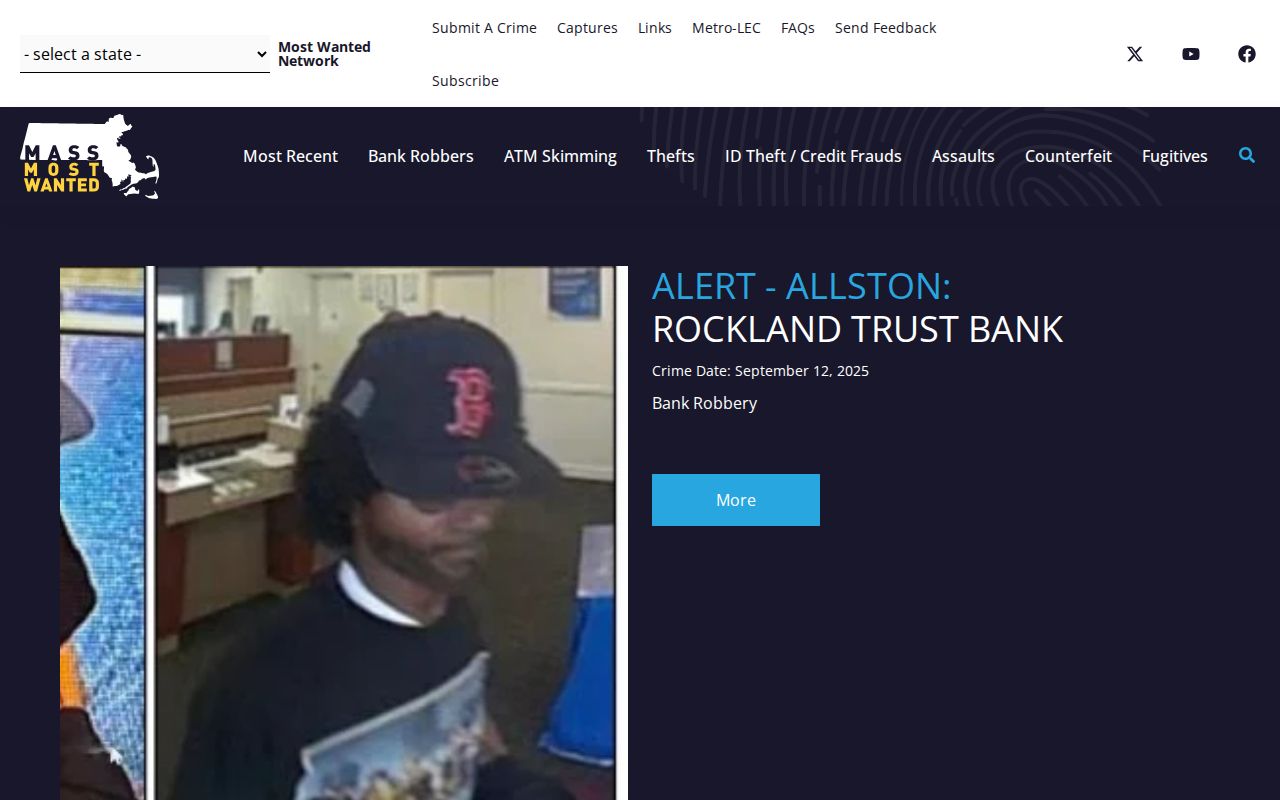
Treat the interface as a tip and case-identification tool. It is not a PCCF roster. Its pictures should stay with their source rather than landing in some local gallery.
Plymouth County Fugitive Tips
No countywide Crime Stoppers line exists here. No blanket anonymity promise, and no Plymouth County reward policy. Individual MassMostWanted entries may display a reward. The site's directions route information straight to law enforcement, so follow each case's instructions as written. If a notice says nothing about money, assume none applies.
Massachusetts State PoliceViolent Fugitive Apprehension Section
Tip line: 800-527-8873
Unit line: 508-820-2121
Immediate danger: 911
State Police numbers come from the official statewide wanted page. For a MassMostWanted entry, use the contact listed with that specific case. A strong tip says what the caller knows and how they came to know it. Rumor, guesswork, and social-media identification can put innocent people at risk.
Check Plymouth County Warrants
A wanted page is a hand-picked public-safety list. Most warrants never appear on one. The Sheriff's Warrant Apprehension Unit enforces warrants, but its page offers no name search, daily feed, warrant count, or online check form. MassCourts can help you locate a case. Still, the public docket interface falls short of a complete warrant database.
The official Massachusetts warrant-check guidance advises anyone who suspects a warrant to consult a lawyer or call the issuing court clerk during business hours. That path confirms and resolves the matter safely. It is not a loophole around court or law enforcement.
- Identify the court connected with the case, missed date, notice, or municipality. Plymouth County matters may be in Brockton, Hingham, Plymouth, Wareham, or Superior Court.
- Speak with defense counsel when possible. Counsel can contact the clerk, confirm the proper division, and explain the court’s instructions.
- Contact the issuing clerk directly. Give accurate identity and case details, and ask what the court can confirm through its official process.
- Follow the lawyer’s and court’s directions for appearance, surrender, bail, or another lawful resolution. Do not rely on a private search page.
Plymouth District Court sits at 52 Obery Street, Plymouth, MA 02360. The phone number is 508-747-8400. Cases from other towns may belong somewhere else. Brockton District Court covers Brockton, Bridgewater, and several nearby communities, so match the court to the case before you call.
Plymouth County Warrant Types
No public county search labels every warrant type. The broad distinctions that follow explain why the court, not a regional wanted page, is the right place for a personal check.
| Record type | What it means for the lookup |
|---|---|
| Arrest warrant | A court order authorizing arrest in connection with a criminal matter. Confirm it with the issuing court or counsel. |
| Bench warrant | A court-issued order that may follow a failure to appear or comply. The docket and clerk can explain the case-specific status. |
| Wanted notice | A public agency or regional case alert. It may relate to a warrant, but it is not the full warrant system. |
| State DOC escape notice | A separate alert about a person missing from state correctional custody, not an ordinary county warrant listing. |
General Laws chapter 276, section 29 requires a warrant-system check before release or discharge in covered situations. It works as an institutional safeguard, not a public search tool. The check can even reach someone held at PCCF when the new warrant issued from a different court.
Verify Plymouth County Case Outcomes
A wanted listing or booking entry only tells you where a case stands. Charges shift all the time. They can be dropped, reduced, reworked at arraignment, or pushed to trial. In Plymouth County, criminal matters land in the district courts at Brockton, Hingham, Plymouth, and Wareham. Superior Court criminal sessions sit in Brockton.
To trace what actually happened, follow the official court docket instructions and search MassCourts for the division, case number, and full event history. Remote results can lag behind the real file. The clerk-magistrate holds the certified version. When a search turns up nothing, say so plainly instead of reading a wanted notice as a verdict.
Names vanish from wanted pages for many reasons. A detective pulls the listing. An arrest closes it out. A case simply gets updated. None of that proves guilt or dismissal on its own. The same goes for stale listings that stay up long after a case ends. Match the court division and case number when you can, and let the clerk’s record settle the question.